
By MARCUS STEAD
Why do people hold the opinions that they have? What leads two individuals, of similar intellect, to reach completely different conclusions on any given subject matter?
There are three possible answers – the first is they have examined the evidence and have reached their viewpoint based on it.
The second is lived experience – a person who has worked in the NHS, or run a small business, will have reached conclusions based on the day-to-day realities of their working lives.
It’s the third that we’ll focus on in this context – people who form a set of opinions because they want to be seen to be fitting in with a certain crowd.
This can take many forms. How many students waving Palestinian flags on the university campus and repeating the chant of the person with the loudspeaker could answer a basic quiz on the history of the region, even on comparatively recent events of, say, the last 50 years? Not many. Do they know the difference between the PLO and Hamas? Would they recognise a picture of the late Yasser Arafat? If they are so concerned about human rights, why don’t they speak out about the rights of, say, women in Afghanistan or the plight of Imran Khan in Pakistan? Or Jimmy Lai being incarcerated in a Hong Kong prison? Nah, they just want to be seen fitting in with the virtuous leftist crowd on campus. There’s not much more to it than that.

The same mindset is by no means confined to the university campus, and not everybody outgrows it as they enter full adulthood. A sizeable number of people who supported the Remain side in the 2016 referendum were guilty of this. Yes, there were people who argued their case based on logic and relevant expertise. They are worthy of our respect. But there were a lot – and I mean a lot – who supported Remain because they wanted to fit in with a certain crowd. They wanted their peers to regard them as anti-racist, tolerant, cosmopolitan, internationalist, welcoming and well-educated.
Ask them to explain their reasoning, before and after the referendum, and the answers were often very vague. You might have got some waffle about trade and them wanting their child to live in the EU during their university gap year, but there was little in the way of substance to their arguments.
My reasons for supporting Brexit – parliamentary sovereignty, the supremacy of UK courts, the ability to set our own immigration policy, the ability to set our own foreign policy, and the ability to form trade deals with the wider world, in growing economies, where people actually live, didn’t interest them very much.
They were willing to overlook a lot as a result – the EU’s internal corruption, its lack of democracy, its overthrowing of a democratically elected government in Greece, its burdensome regulations that were holding back innovation, its cruel agricultural policy that was preventing Third World farmers from having access to EU markets and lots more besides.
All too often, they were quick to label pro-Brexiteers as thick, racist, bigoted, uneducated, insular, little Englanders and lots more besides. They often did so from their leafy suburban home, which to quite a large extent insulated them from the negative effects of EU membership. To them, being in the EU meant a supply of cheap waiters and cheap nannies. They knew or cared little about the plumber or tradesman who was being undercut, the impact of wage suppression from the oversupply of cheap labour, or what it’s like to be on a housing register where demand massively outstrips supply.
A Brexiteer, no matter how well-educated, logical, rational and polite would have been an uncomfortable if not unwelcome presence at the Saturday night dinner party.
At the Last Night of the Proms each year, the campaign group, Thank EU for the Music, hands out free EU flags outside the Royal Albert Hall for people to take in and wave during the performances. Neither the campaign group nor the people waving the flags are exactly being discouraged by the BBC.

I can think of a number of people in my own life who let their masks slip on the morning it became apparent that the Leave side had won the referendum. I’m talking about people who like to be very virtuous about their internationalist and tolerant credentials who quickly showed themselves to be ill-mannered bad losers when things don’t go their way.
There is a section of British society that has spent the last decade in a sort of middle class intellectual sulk. They never did accept the result of the referendum, but their major fault is that they haven’t updated their arguments to reflect how the EU itself has changed in the last ten years.
I include Labour and Lib Dem politicians in that statement. Andrew Burnham’s main weakness appears to be foreign policy, an area in which he has little experience or expertise. He has, to quite a large extent, delegated responsibility on foreign affairs to Edward Miliband and the Foreign Office.
Even so, Mr Burnham has said he wants to see the UK rejoin the EU in the long-term. This week’s Labour conference in Liverpool was massively different in demographic to how it would’ve looked decades ago. This was a conference hall consisting of the middle class lanyard-wearing public sector worker, the charity worker and the university student. They spent most of the conference engaging in student union-style politics, even though in many cases they are far too old for it. To put it another way, there wouldn’t have been many entrepreneurs, small business owners or military veterans among the delegates.
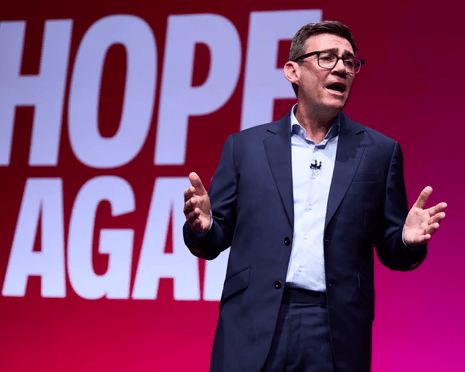
But an important question to ask Mr Burnham, or anybody else who shares his mindset, is why, in 2026, do they want the UK to join the EU? Have they thought it through, or is this merely a case of them wanting to be seen as nice, tolerant and internationalist?
They talk as though joining the single market and customs union, as a prelude to rejoining the EU, would magically transform the UK’s growth prospects. Nothing could be further from the truth.
The EU’s three biggest economies, Germany, France and Italy, are stagnant, and while the UK’s growth figures of the last five years have been nothing to write home about, they have nevertheless been higher than those three countries in each of the last five years bar one. Yes, that’s right, the UK’s economy has consistently grown by a larger figure than the EU powerhouses, despite being outside the single market and customs union. In some years, it has grown by two to three times as much as the EU’s ‘big three’.
Throwing our lot in with the slowest-growing group of economies in the developed world would not be a smart move.
Now let’s look at the political climate of those three countries: in France, Emmanuel Macron’s polling figures are dire, and every poll, no matter what spin you put on it, shows that Marine le Pen of the populist-right National Rally is set to become the country’s president next year.
In Germany, the very ‘hard right’ AfD has won two state elections in the east of the country during the last month. It also has a comfortable lead in the national polls. If a general election was held now, the AfD would likely have as many seats as the Christian Democrats and Social Democrats combined. Let that sink in. Even so, it wouldn’t be able to form a government because no other party will work with them.
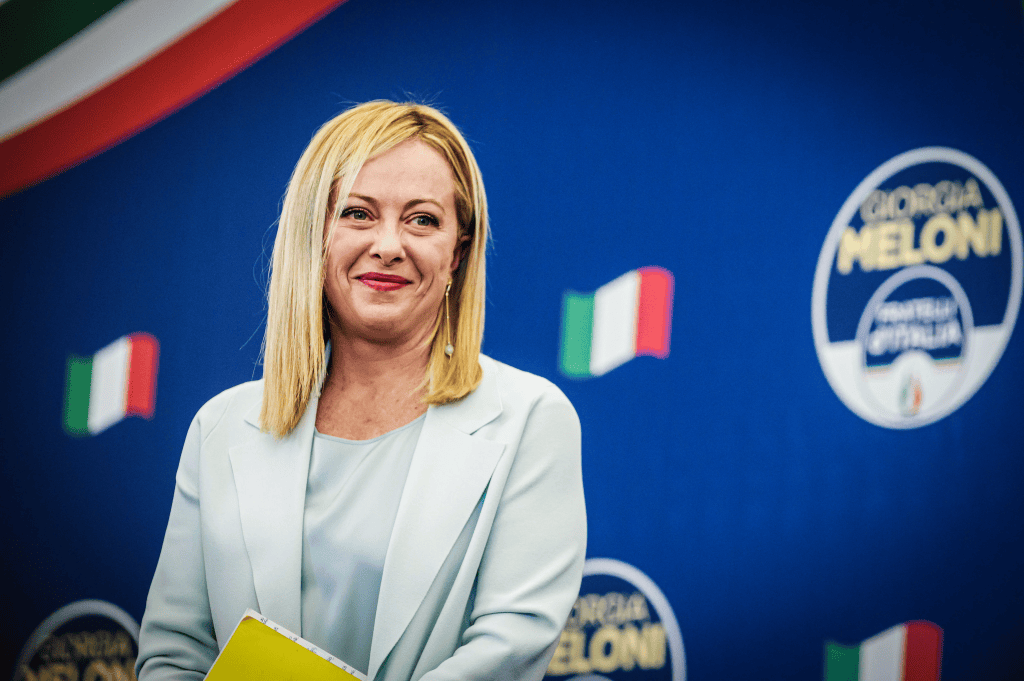
In Italy, Giorgia Meloni’s Fratelli d’Italia is set to be re-elected next year. It was frequently referred to as “far-right” by the BBC and other sections of the mainstream media when it initially came to power, but that has faded away with time. Meloni’s government gets referred to as the “most right-wing” in Italian history, but she has brought a sustained period of stability to Italian politics, and she is a stateswoman on the world stage. Her blunt speaking is also a breath of fresh air.
Beyond that, almost half the European Parliament is made up of varying shades of Right. Just four of the EU’s 27 commissioners are on the left. When new EU judges are appointed, they will reflect the populist right, in much the same way the Supreme Court judges in the USA reflect President Trump’s world view.
Spain, the Netherlands and Romania are all set to move firmly to the right in elections held during 2027.
There are sound reasons not to like the AfD and National Rally. The left’s initial hysteria over Giorgia Meloni looks absurdly overstated now, but even so, none of these are Mr Burnham, Mr Miliband or indeed Ed Davey’s type of people.
There’s also a real lack of deep thought into what rejoining the EU would actually entail. The UK would be under enormous pressure to join the euro and the Schengen free travel area. The rebate on EU membership fees negotiated by Margaret Thatcher during the 1980s and lasted until we left the bloc would not exist this time around.
What’s especially odd is the enthusiasm by the Europhiles for the customs union. They don’t appear to know what it actually is. Let’s be absolutely clear about one thing – joining the customs union does not and will not mean the end of customs checks. It does, however, mean that all member countries charge the same import duties for non-members.
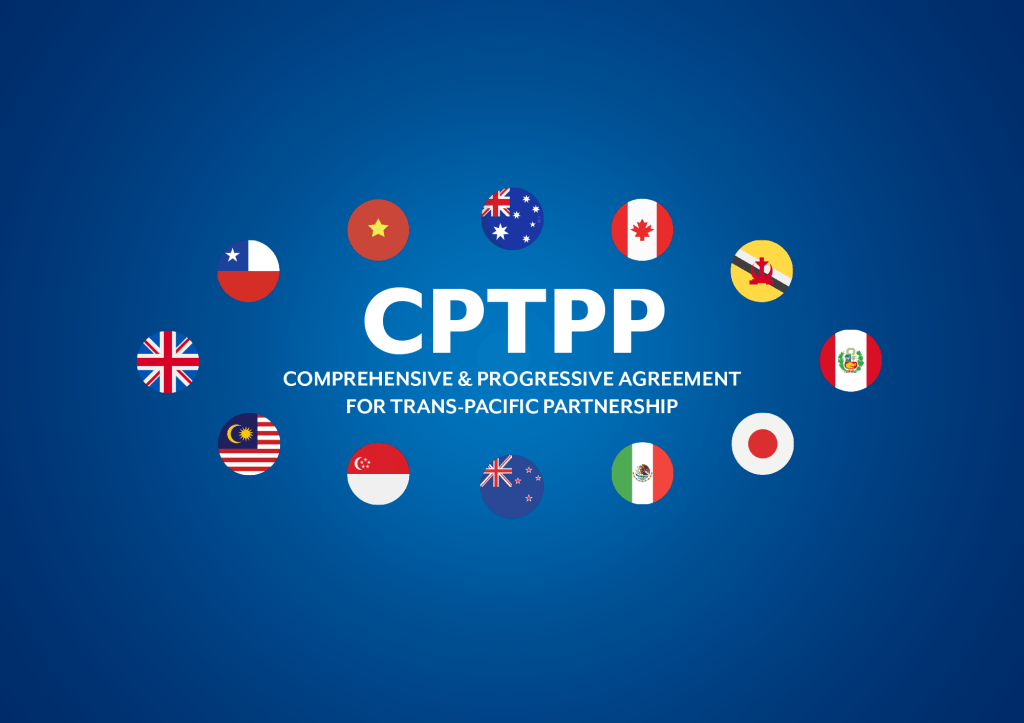
Being inside the EU customs union would mean scrapping every trade deal we’ve signed since we left: Australia, Japan, India, the Gulf states – they’d all have to go. This, at a time when the Pacific trade nexus, the CPTPP is expanding, and countries as far and wide as Indonesia, Taiwan, Costa Rica and Ecuador, are applying to join the UK in it. If the UK rejoined the EU, we would, by definition, have to leave CPTPP.
There would also be the smaller, but irritating changes. The contactless card limit would immediately drop from £100 to £50. Do remember that this Labour government rather likes the freedoms Brexit brings when it suits it to do so, such as imposing 20% VAT on private school fees as an act of socialist spite. But that would have to go if the UK rejoined. Mr Burnham removing the 5% VAT on energy bills would be illegal under EU law.
Europhiles either don’t understand what the customs union is, or they see it as a gateway to full EU membership. Either way, joining it would be hugely damaging.
The UK is currently third in the world when it comes to developing AI, significantly behind the USA and China, but streets ahead of the EU, which is pretty much a nonentity in AI due to its heavy regulation and restrictions.
In other areas, the UK has diverged from EU policy to suit its own national interest – gene editing, targeted agricultural support, lifting the cap on bankers’ bonuses and freeports to name a few.
We have also been spared the sleaze and corruption of the EU, which is nothing new in itself, but has continued apace since the UK left.
For example, there was the 2022 banknotes scandal, where MEPs were arrested when Belgian police found half a million euros in their homes, apparently to be distributed as bribes to Arab governments. We heard little about it in our own news bulletins – we’d left the bloc, it wasn’t our concern, but such matters would be in the forefront if we were to even consider rejoining.
The EU isn’t the beacon of freedom, tolerance and democracy its supporters make it out to be, either at multinational or national level. In 2011, the EU imposed unelected, technocratic governments on Greece and Italy. In 2014, it overthrew an unlovely, but nevertheless democratically-elected government in Ukraine. It imposed a heavy fine on Italy when it was fighting the pandemic. In Romania last year, a candidate who looked as though he was going to win the presidential election was banned.
Going back to France, the establishment banned Marine Le Pen from public office and handed her a suspended prison sentence when she looked like a credible threat to Macron (a court eventually overturned the ban in July this year and, as already stated, she’ll very likely win next year).
Two years ago in Germany, a parliament was thrown out by the people and a new one elected, but in the period after the election before the new one could take over, the old one made vast borrowing commitments to fund the Ukraine war, effectively binding its successor.
Three years ago in Poland, a new government led by Prime Minister Donald Tusk, darling of the Remainers a decade ago, was to ban a TV station it didn’t like.
It’s entirely possible that Mr Burnham largely knows most of this and is merely throwing some red meat to his support base. People say he’s a shrewd political operator – I, personally don’t see it, and he comes across as naïve and poorly-briefed on foreign affairs, but time will tell. The most likely scenario is that he will become massively unpopular around January when high energy bills start landing on people’s doormats as a consequence of absurd ‘Net Zero’ policies combined with the Strait of Hormuz remaining closed (the wide-ranging, serious consequences of it staying shut for much longer aren’t being talked about nearly enough).
Mr Burnham must also, surely, be aware that any attempt to rejoin the EU would dominate the political climate and toxify debate for years to come, as it did in and after 2016, to the point where the policy agenda he set out during his speech this week would be unachievable.
The pressing matters – the need to get Britain’s eye-watering public debt levels under control, the desperate need for welfare reform (don’t hold your breath on that happening with this government), properly securing our borders (don’t hold your breath on that, either) and lots more would go on the backburner. The EU issue would be at the forefront, everything else would need to be sacrificed or given low priority.
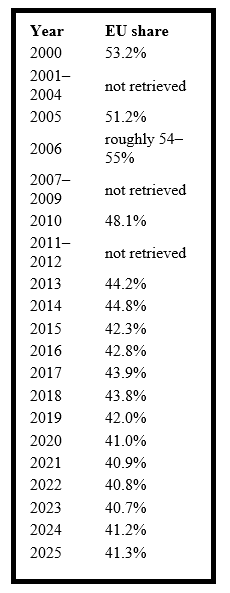
The percentage of UK exports going to the EU had been in decline long before the Brexit referendum. In 2000, the figure was 53.2%. That figure had fallen to 48.1% by 2010. In 2016, the year of the referendum, it stood at 42.8%. By last year, it had dropped further to 41.3%.
It’s time to look to the future. The UK has little to gain and a huge amount to lose from EU membership. The EU’s heavy-regulation, high-interventionist approach is not a winning strategy in the 21st century.
When you encounter the section of British society that has never truly accepted the result of the referendum a decade ago, calmly state the arguments outlined in this article. You may encounter an open, receptive mind, but prepare yourself for a response consisting of outdated arguments, and, if they’re worshippers of LBC radio presenter James O’Brien, you can also expect a condescending, sneering attitude along with cheap insults.


